Dark Patterns or Bad Design? A Study on the Consequences of Deceptive Design

Dark patterns are everywhere — from hidden fees to trick questions disguised as buttons. This research investigated how such manipulative and misleading UX tactics shape user trust and decision-making, and whether people realize when they’re being deceived. The findings reveal how these patterns affect both user behavior and long-term brand credibility.

Tallinn University &
Cyprus University of Technology / 2022

UX Design

UI design

UX writing

UX Research

User Research

Prototyping

Master Thesis
Problem & Significance

Dark patterns are interface elements designed to deceive users into performing unintended actions with potentially damaging consequences. They have a negative impact on the user experience, with users attaching negative sentiments to experiences with deceptive elements
(Gray et al., 2021).

Despite growing research into dark patterns, there is a need to address the extent and nature of human interactions with dark patterns and similar-looking, non-malicious elements. A research gap regarding the user’s emotions, and consequences for users and companies still exists. 

Problem

Dark patterns are everywhere (95% of popular mobile apps use at least one).

Users struggle to distinguish between intentional deception and bad design.

This creates frustration, mistrust, and long-term damage for companies.

Dark patterns are everywhere (95% of popular mobile apps use at least one). Users struggle to distinguish between intentional deception and bad design. This creates frustration, mistrust, and long-term damage for companies.

Solution

Built a realistic airline booking prototype filled with dark patterns, anti-patterns, and standard patterns. Ran user tests where participants:

  • Clicked a “Deception” button when they felt misled.

  • Were interviewed about their perceptions.

  • Had facial expressions recorded to capture subconscious reactions.

Results

Users clicked “Deception” more often in response to anti-patterns than actual dark patterns.

  • Subconscious recognition was 1.59× higher than conscious recognition.

  • Users expressed anger, disgust, contempt, and joy when manipulated — but similar emotions also surfaced with simple bad design.

  • Most participants said dark patterns harm trust and ultimately hurt the company.

Research Overview
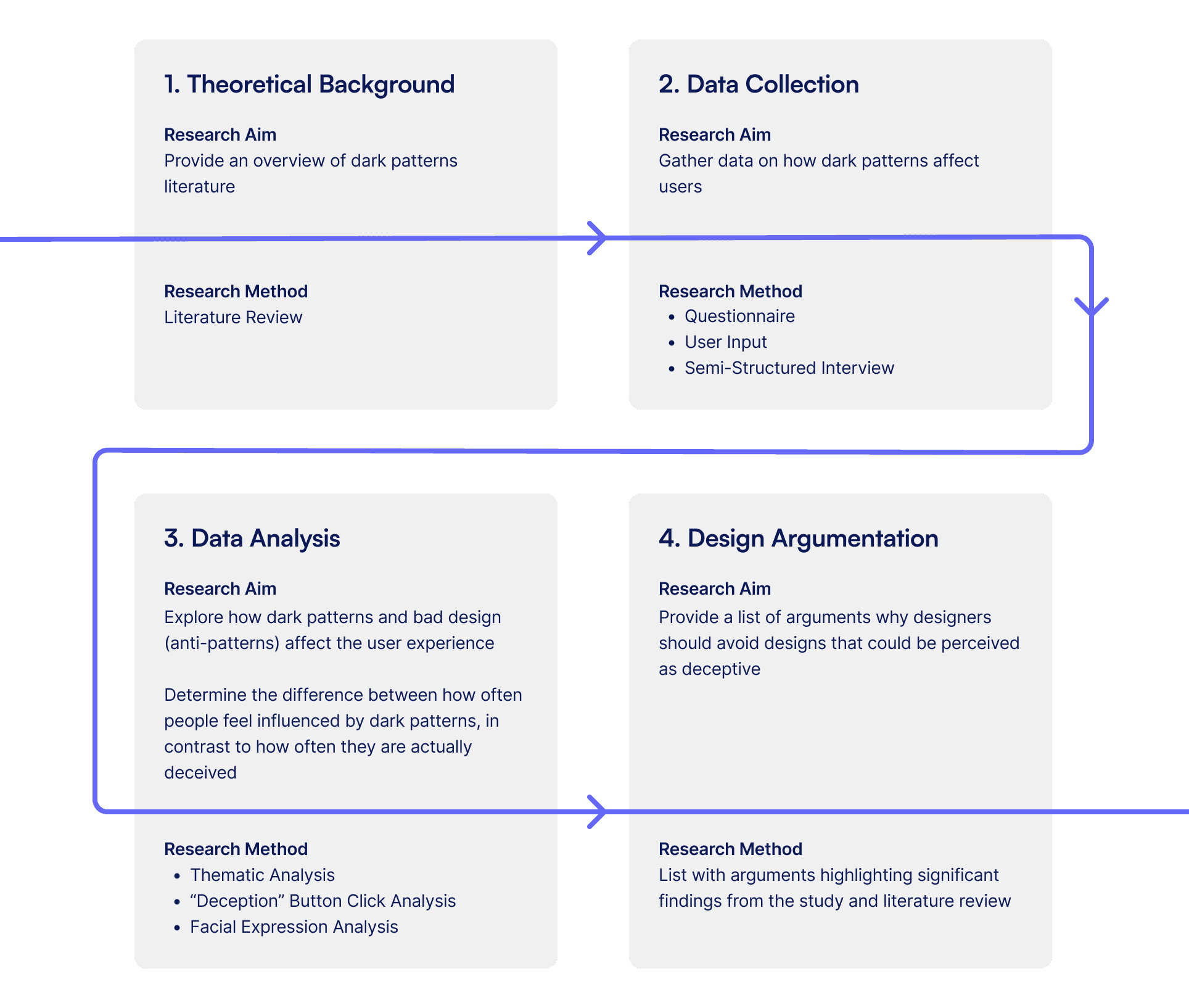
Theoretical Background

Dark patterns are interface elements designed to trick users into taking unintended actions. They negatively affect the user experience and can damage trust. Despite growing research, there was still a gap in understanding:

  • How do users consciously vs. subconsciously respond to these patterns?

  • Do they sometimes mistake bad design for deception?

  • What does this mean for user trust and for the companies deploying such patterns?

These questions set the foundation for my research.

Research

To investigate how users react to dark patterns versus bad design, I designed a prototype airline booking flow and ran a study with 11 participants. They were asked to complete booking tasks, flag deception when they noticed it, and share their thoughts in interviews — while their facial expressions were recorded to capture subconscious reactions.

This mixed-method approach gave me both quantitative insights (clicks, recognition rates, emotions) and qualitative insights (user perceptions, trust, and frustration).

Theoretical Background

Dark patterns are interface elements designed to trick users into taking unintended actions. They negatively affect the user experience and can damage trust. Despite growing research, there was still a gap in understanding:

  • How do users consciously vs. subconsciously respond to these patterns?

  • Do they sometimes mistake bad design for deception?

  • What does this mean for user trust and for the companies deploying such patterns?

These questions set the foundation for my research.

Research

To investigate how users react to dark patterns versus bad design, I designed a prototype airline booking flow and ran a study with 11 participants. They were asked to complete booking tasks, flag deception when they noticed it, and share their thoughts in interviews — while their facial expressions were recorded to capture subconscious reactions.

This mixed-method approach gave me both quantitative insights (clicks, recognition rates, emotions) and qualitative insights (user perceptions, trust, and frustration).

Theoretical Background

Dark patterns are interface elements designed to trick users into taking unintended actions. They negatively affect the user experience and can damage trust. Despite growing research, there was still a gap in understanding:

  • How do users consciously vs. subconsciously respond to these patterns?

  • Do they sometimes mistake bad design for deception?

  • What does this mean for user trust and for the companies deploying such patterns?

These questions set the foundation for my research.

Research

To investigate how users react to dark patterns versus bad design, I designed a prototype airline booking flow and ran a study with 11 participants. They were asked to complete booking tasks, flag deception when they noticed it, and share their thoughts in interviews — while their facial expressions were recorded to capture subconscious reactions.

This mixed-method approach gave me both quantitative insights (clicks, recognition rates, emotions) and qualitative insights (user perceptions, trust, and frustration).

Results

The study uncovered clear differences between conscious and subconscious recognition, strong emotional responses, and lasting effects on trust.
  1. How do dark patterns and anti-patterns affect the user experience?

  1. How do dark patterns and anti-patterns affect the user experience?

  1. How do dark patterns and anti-patterns affect the user experience?

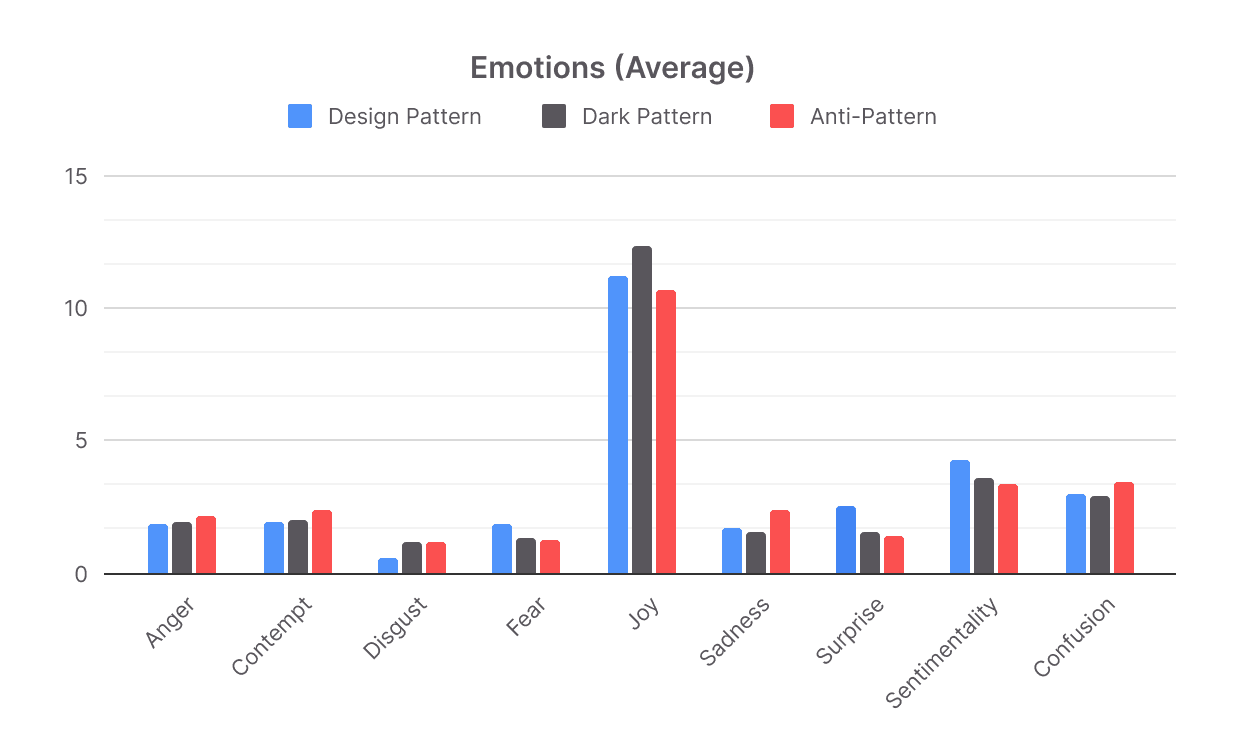
👉🏻 Both dark patterns and anti-patterns triggered negative emotions such as anger, disgust, contempt, and even joy.

This shows that bad design can feel just as manipulative as intentional deception.

👉🏻 Both dark patterns and anti-patterns triggered negative emotions such as anger, disgust, contempt, and even joy.

This shows that bad design can feel just as manipulative as intentional deception.

Emotions emerged not only for dark patterns, but also for simple bad design (anti-patterns), showing how harmful non-malicious flaws can be.

Emotions emerged not only for dark patterns, but also for simple bad design (anti-patterns), showing how harmful non-malicious flaws can be.

  1. How often do people, consciously or subconsciously, recognise dark patterns?

  1. How often do people, consciously or subconsciously, recognise dark patterns?

  1. How often do people, consciously or subconsciously, recognise dark patterns?

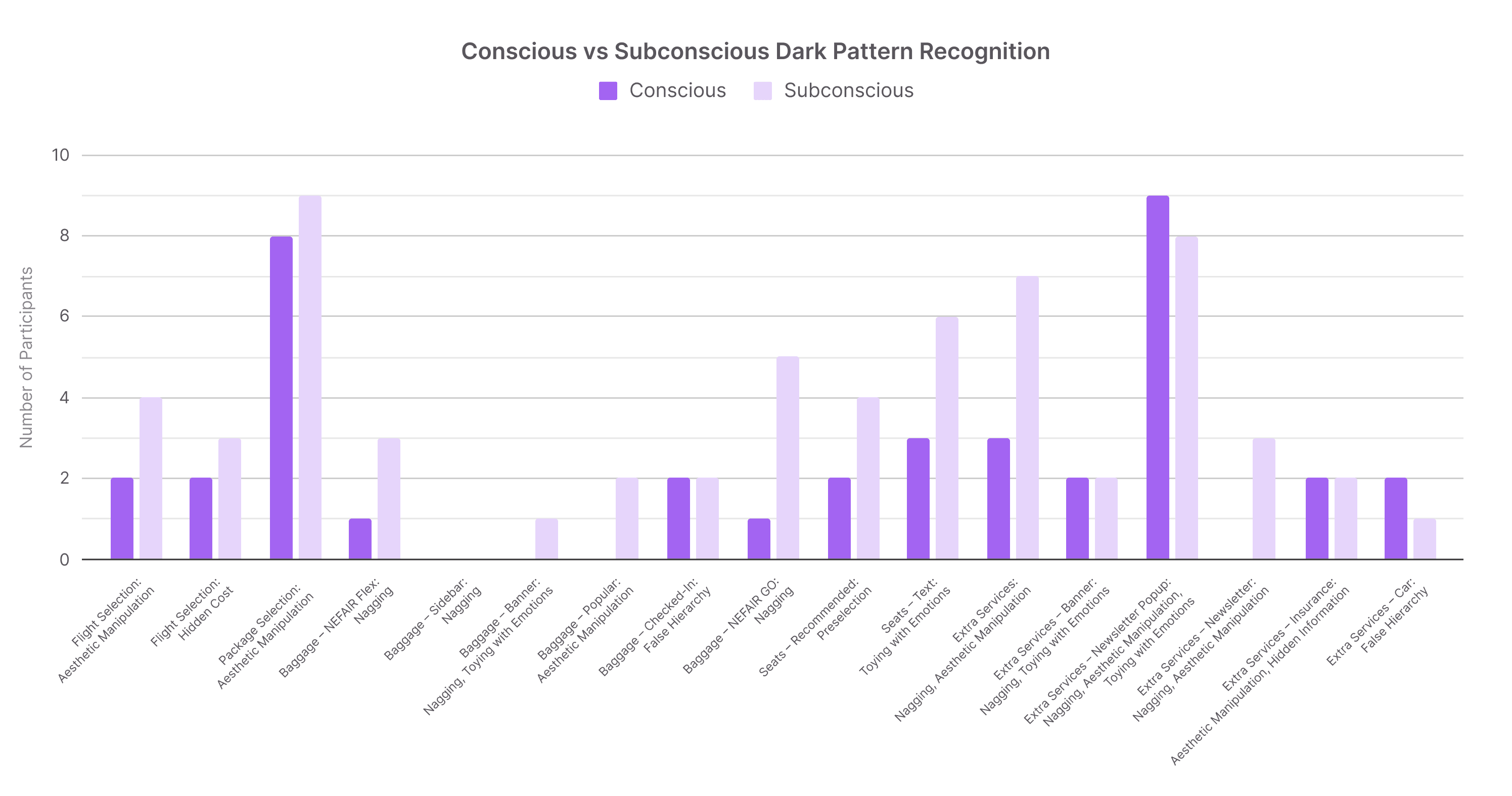
👉🏻 Participants recognised dark patterns 1.59× more often subconsciously than consciously. Many users felt manipulated but could not articulate why.

👉🏻 Participants recognised dark patterns 1.59× more often subconsciously than consciously. Many users felt manipulated but could not articulate why.

Subconscious recognition was significantly higher than conscious detection, suggesting users often feel manipulated without knowing how to explain it.

Subconscious recognition was significantly higher than conscious detection, suggesting users often feel manipulated without knowing how to explain it.

  1. How often do people mistake bad design for dark patterns or for being deceived?
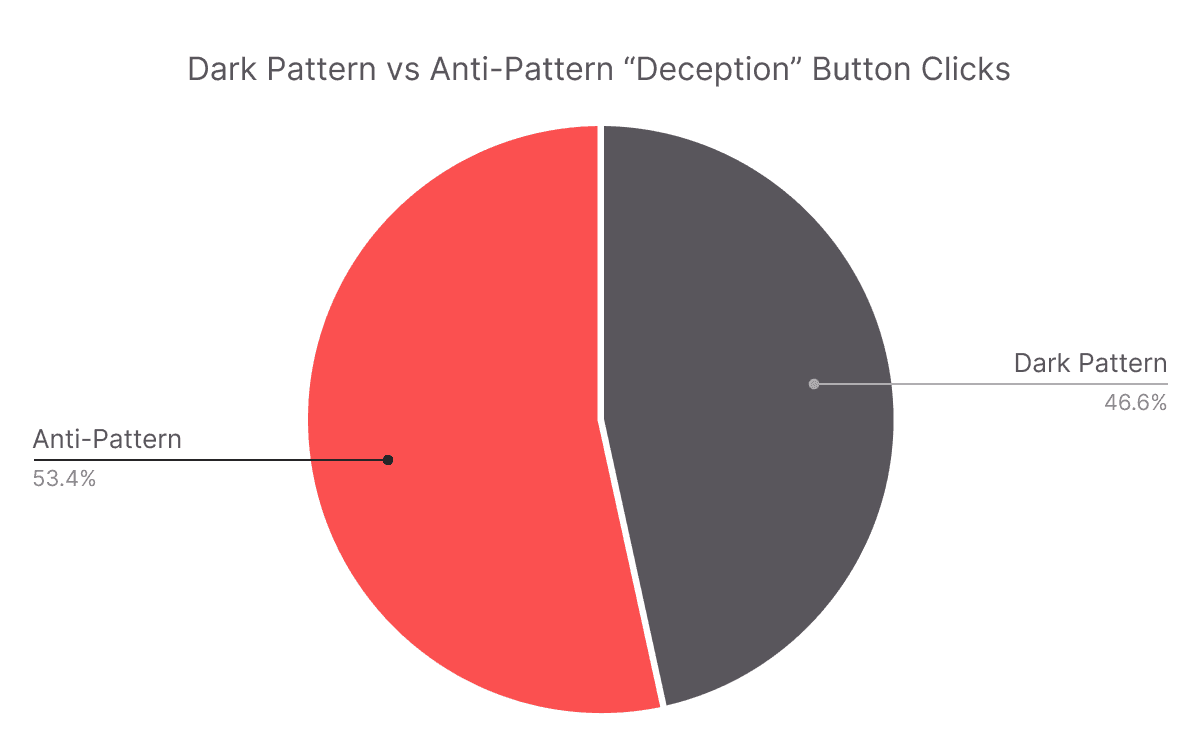
👉🏻 Participants clicked the “Deception” button more often in response to anti-patterns (53.4%) than to actual dark patterns (46.6%). This shows that users frequently mistook bad design for manipulative intent, blurring the line between design flaws and deliberate deception.

👉🏻 Participants clicked the “Deception” button more often in response to anti-patterns (53.4%) than to actual dark patterns (46.6%). This shows that users frequently mistook bad design for manipulative intent, blurring the line between design flaws and deliberate deception.

Participants flagged deception more often for anti-patterns (bad design) than for actual dark patterns, suggesting that confusing or flawed design can feel just as deceptive.

Participants flagged deception more often for anti-patterns (bad design) than for actual dark patterns, suggesting that confusing or flawed design can feel just as deceptive.

  1. What are compelling reasons for designers to avoid designs that could be perceived as deceptive?

👉🏻 The findings show that designers should avoid deceptive designs for several reasons:

  • Users can recognise deception subconsciously, even if they cannot articulate it. This recognition still leads to a negative impact on the user experience.

  • People often feel deceived not only by dark patterns but also by bad design (anti-patterns) — even unintentional flaws can harm trust.

  • Companies risk losing customers when users find a website frustrating, misleading, or untrustworthy.

  • Dark patterns may provide short-term business gains, but they damage user satisfaction, trust, and credibility in the long term.

  • Users often hold designers accountable for manipulative practices, and such work can “reflect badly on the profession.”

👉🏻 The findings show that designers should avoid deceptive designs for several reasons:

  • Users can recognise deception subconsciously, even if they cannot articulate it. This recognition still leads to a negative impact on the user experience.

  • People often feel deceived not only by dark patterns but also by bad design (anti-patterns) — even unintentional flaws can harm trust.

  • Companies risk losing customers when users find a website frustrating, misleading, or untrustworthy.

  • Dark patterns may provide short-term business gains, but they damage user satisfaction, trust, and credibility in the long term.

  • Users often hold designers accountable for manipulative practices, and such work can “reflect badly on the profession.”

"It was a massive distrust of the company and not wanting ever to have anything to do with them again.”

"It was a massive distrust of the company and not wanting ever to have anything to do with them again.”

"The more people are exposed to them and start to recognise them, the less effect they will have … that’s a road to nowhere.”

"The more people are exposed to them and start to recognise them, the less effect they will have … that’s a road to nowhere.”